ER = EPR, the Big Bounce, string theory versus loop quantum gravity and the Cosmic Microwave Background
The ER = EPR conjecture proposes that quantum entanglement and spacetime wormholes are two different descriptions of the exact same underlying physical phenomenon, while cyclic universe models—such as Loop Quantum Cosmology's Big Bounce and Roger Penrose's Conformal Cyclic Cosmology—suggest our Big Bang was not the absolute beginning of time, but rather a transition from a previous cosmic aeon.
1. How Quantum Entanglement Stitches Spacetime Together (ER = EPR)
In 2013, theoretical physicists Juan Maldacena and Leonard Susskind proposed the ER = EPR conjecture, named after two famous 1935 papers co-authored by Albert Einstein: the Einstein-Rosen (ER) bridge (a mathematical wormhole connecting two black holes) and the Einstein-Podolsky-Rosen (EPR) paradox (quantum entanglement, which Einstein famously called "spooky action at a distance").
Wormholes Are Entanglement. Maldacena and Susskind suggested that whenever two black holes become quantum-entangled, they are connected through their interiors by a non-traversable spacetime wormhole. Going even further, they proposed that any pair of entangled subatomic particles is linked by a microscopic Planck-scale quantum wormhole.
Emergent Spacetime. Building on this idea, physicists discovered that if you take a collection of quantum bits (qubits) with zero entanglement, spacetime effectively fragments into disconnected dust. Conversely, weaving vast networks of quantum entanglement between particles stitches smooth, continuous space together—meaning geometry and distance are literally built out of quantum information.
No Faster-Than-Light Travel. Despite connecting distant points in space, ER = EPR strictly obeys Einstein's cosmic speed limit. Just as standard quantum entanglement cannot transmit usable messages faster than light, the corresponding Einstein-Rosen wormhole pinches off too quickly for a person or light signal to cross from one mouth to the other.
2. The Big Bounce and Conformal Cyclic Cosmology
Rather than treating the Big Bang as a singular creation event out of nothing, cyclic models propose that the cosmos undergoes an endless series of births and rebirths.
Loop Quantum Cosmology's Big Bounce. In standard general relativity, rewinding the expanding universe backward crushes all matter into a point of infinite density (a singularity) where the laws of physics break down. Loop Quantum Gravity—which treats space itself as woven from tiny, discrete quantum loops rather than a smooth fabric—shows that once a collapsing universe reaches a maximum Planck density, space exerts a powerful quantum repulsive force. Instead of crushing into a singularity, the contracting cosmos rebounds outward in a Big Bounce, turning a previous universe's Big Crunch into our Big Bang.
Penrose's Conformal Cyclic Cosmology (CCC). Proposed by Nobel laureate Roger Penrose, CCC links an infinitely expanding Heat Death directly to a new Big Bang without needing the universe to collapse first. Penrose noted that in the distant future—after all matter has decayed and every black hole has evaporated—only massless photons remain. Because massless particles travelling at the speed of light do not experience time or distance, the universe loses its sense of scale, becoming mathematically identical ("conformally equivalent") to the ultra-hot, dense state of a brand-new Big Bang.
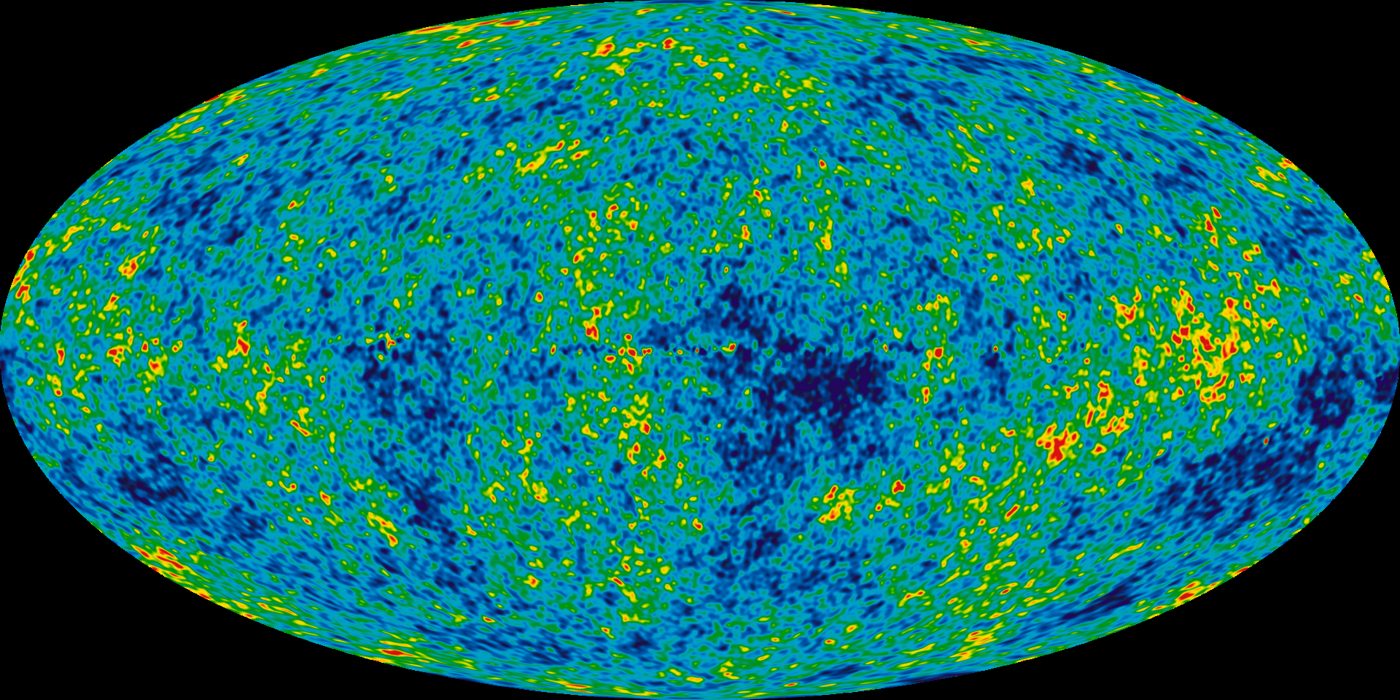
Hunting for "Hawking Points" in the Sky. Penrose and his collaborators have searched the Cosmic Microwave Background (CMB)—the leftover afterglow of our Big Bang—for faint circular rings and anomalously warm spots ("Hawking points"), arguing they could be gravitational-wave echoes or radiation scars left behind by evaporating supermassive black holes from the previous cosmic aeon.
Loop Quantum Gravity and String Theory are the two primary theoretical frameworks attempting to unify Einstein's general relativity with quantum mechanics into a single "theory of everything," while the Cosmic Microwave Background (CMB) is the oldest light in the universe—a faint thermal snapshot from 380,000 years after the Big Bang whose tiny temperature ripples encode the cosmic recipe of dark matter, dark energy, and the seeds of every galaxy.
1. Loop Quantum Gravity vs. String Theory
Modern physics rests on two wildly successful pillars that clash at extreme scales: general relativity (which describes gravity as smooth curves in spacetime) and quantum mechanics (which describes the subatomic world as discrete, probabilistic packets).
String Theory
Vibrating One-Dimensional Strings. String theory replaces point-like elementary particles (such as electrons and quarks) with unimaginably tiny, vibrating one-dimensional loops of energy. Just as a violin string produces different musical notes depending on how it vibrates, a fundamental string appears as different particles depending on its vibrational frequency—with one specific vibration naturally producing the graviton, the hypothetical quantum particle of gravity.
Extra Hidden Dimensions. For the mathematics of string theory to remain consistent without producing impossible probabilities, the universe must contain 10 or 11 dimensions—our familiar three dimensions of space and one of time, plus six or seven extra spatial dimensions curled up so tightly at every point in space that we cannot see them.
Strengths and Challenges. String theory elegantly unifies all four fundamental forces of nature and gave birth to powerful tools like the AdS/CFT holographic correspondence, though it predicts a vast "landscape" of 10⁵⁰⁰ possible vacuum states and requires energy levels far beyond current particle accelerators to test directly.
Loop Quantum Gravity (LQG)
Quantising Space Itself. Rather than adding extra dimensions or unifying all forces at once, Loop Quantum Gravity focuses strictly on applying quantum mechanics directly to Einstein's geometry of spacetime.
Atoms of Space. LQG predicts that space is not infinitely smooth or continuous. Zoomed down to the microscopic Planck scale (10⁻³⁵ metres), spacetime is woven from a finite network of tiny, discrete quantum loops—often visualised as spin networks—meaning there is a smallest possible unit of area and volume in the universe.
Eliminating Singularities. Because space cannot be compressed smaller than its fundamental quantum loops, LQG naturally prevents infinities from forming inside black holes or at the Big Bang, leading directly to the Big Bounce model instead of a singularity.
2. The Cosmic Microwave Background (CMB)
Discovered accidentally in 1965 by Arno Penzias and Robert Wilson as a persistent background hiss in a radio antenna, the Cosmic Microwave Background is the leftover thermal radiation from the fiery birth of the universe.
The Moment the Universe Turned Transparent. For the first 380,000 years after the Big Bang, the universe was an opaque, glowing soup of superheated plasma—protons, electrons, and photons constantly colliding so light could not travel far without scattering. Once cosmic expansion cooled the universe to roughly 3,000 Kelvin (2,700 °C), electrons paired up with protons to form neutral hydrogen atoms (an event called Recombination), suddenly allowing trapped light to stream freely across space forever.
Stretched Into Microwaves. Over the past 13.8 billion years, the expansion of space has stretched that ancient visible glow by a factor of about 1,100, cooling it down to a frigid 2.725 Kelvin (-270.4 °C) in the microwave part of the electromagnetic spectrum.
What the Temperature Ripples Reveal. Precision space missions—COBE, WMAP, and ESA's Planck satellite—mapped the CMB across the entire sky, discovering tiny temperature fluctuations of just one part in 100,000. Those microscopic warm and cool spots represent primordial sound waves rippling through the early plasma, revealing that our universe is geometrically flat and composed of roughly 68% dark energy, 27% dark matter, and only 5% ordinary atomic matter—with the slightly denser cool spots serving as the gravitational seeds that grew into today's galaxies and cosmic web.