Comet Interceptor, the Rubin Observatory, Project Lyra, Lagrange points and the Lucy mission
The ESA/JAXA Comet Interceptor mission is a "park-and-wait" spacecraft designed to launch before its target is even discovered, while the Vera C. Rubin Observatory uses the largest digital camera ever built for astronomy to scan the entire southern sky every few nights and spot incoming interstellar objects early enough for intercept missions to reach them.
1. The ESA/JAXA Comet Interceptor Mission
Traditionally, space missions take a decade or more to plan and build after a target is chosen. Because interstellar visitors and pristine long-period comets are spotted only months before they sweep past the Sun and vanish back into deep space, standard missions cannot launch in time to catch them.
Parking at Lagrange Point L2. Planned for launch in late 2028 or 2029 alongside ESA's ARIEL space telescope, Comet Interceptor will travel to the Sun-Earth L2 point—a gravitationally stable spot 1.5 million kilometres behind Earth. There, it will enter a waiting halo orbit for up to three or four years until telescopes spot a reachable pristine comet or interstellar object.
Three-Spacecraft Multi-Point Flyby. Once a target is selected, Comet Interceptor will fire its thrusters to cross the visitor's path. One to two days before the high-speed encounter, the main spacecraft (Spacecraft A) will release two smaller sub-probes—one built by JAXA (Probe B1) and one by ESA (Probe B2).
Capturing a 3D Profile. While the main spacecraft stays at a safer distance of about 1,000 kilometres to avoid damaging dust impacts, the two smaller probes will dive closer (850 km and 400 km) to map the object's nucleus, gas coma, and interaction with the solar wind simultaneously from multiple angles.
2. How the Vera C. Rubin Observatory Finds Interstellar Objects
Located atop Cerro Pachón in Chile, the Vera C. Rubin Observatory began full science operations and real-time alert streams in 2026, transforming how astronomers hunt for faint, fast-moving objects across the solar system.
The 3,200-Megapixel LSST Camera. Rubin houses the largest digital camera ever constructed for astronomy—roughly the size of a small car—paired with an 8.4-metre wide-field mirror. Every 40 seconds, it snaps an ultra-deep image covering an area of sky 45 times larger than the full Moon, allowing it to photograph the entire visible southern sky every three to four nights.
Automated Real-Time Alerts. Sophisticated software compares each new image against a master template of the static sky. Within two minutes of an exposure, the system flags anything that has moved or changed brightness, issuing up to seven million public alerts per night so telescopes worldwide can immediately track suspicious objects.
Spotting Dozens of Interstellar Visitors. Because Rubin can detect objects far fainter and farther away than older survey telescopes, astronomers estimate it will uncover roughly 10 to 70 new interstellar objects over its 10-year Legacy Survey of Space and Time. Crucially, spotting an interstellar visitor while it is still out near Jupiter or Saturn gives missions like Comet Interceptor the months of lead time needed to plot an intercept course.
Project Lyra is a mission concept designed to overtake fast-moving interstellar visitors like 1I/'Oumuamua using extreme rocket manoeuvres close to the Sun, while Lagrange points are five orbital "sweet spots" where the gravitational pulls of two massive bodies balance out so a spacecraft can park with minimal fuel.
1. Project Lyra: Chasing Down 'Oumuamua
Proposed by the Initiative for Interstellar Studies shortly after 1I/'Oumuamua was spotted in 2017, Project Lyra explores whether existing rocket technology could catch an interstellar object that is already racing out of the solar system faster than Voyager 1.
The Speed Problem. 'Oumuamua is escaping the Sun at roughly 26 kilometres per second (58,000 mph)—about 50% faster than Voyager 1. To catch up, a spacecraft must accelerate to even higher speeds using a super-heavy launcher (such as SpaceX's Starship or NASA's SLS) paired with multiple planetary gravity assists.
The Solar Oberth Manoeuvre. The signature move in Project Lyra is a daring dive toward the Sun. After using a Jupiter gravity assist to kill its orbital momentum and fall inward, the probe skims within a few solar radii of the Sun's surface—protected by a thick carbon-composite heat shield similar to the Parker Solar Probe. At the exact moment of maximum speed during this close pass, the spacecraft fires a solid rocket motor, multiplying its kinetic energy through the Oberth effect (which makes rocket burns far more efficient when a craft is already moving at peak velocity).
Arrival Timeline. Depending on launch windows in the late 2020s or early 2030s, a Project Lyra spacecraft could catch up to 'Oumuamua roughly 22 to 26 years after launch—overtaking it well beyond the orbit of Pluto to snap high-resolution photos and measure its exact composition.
2. Lagrange Points: Cosmic Parking Spots
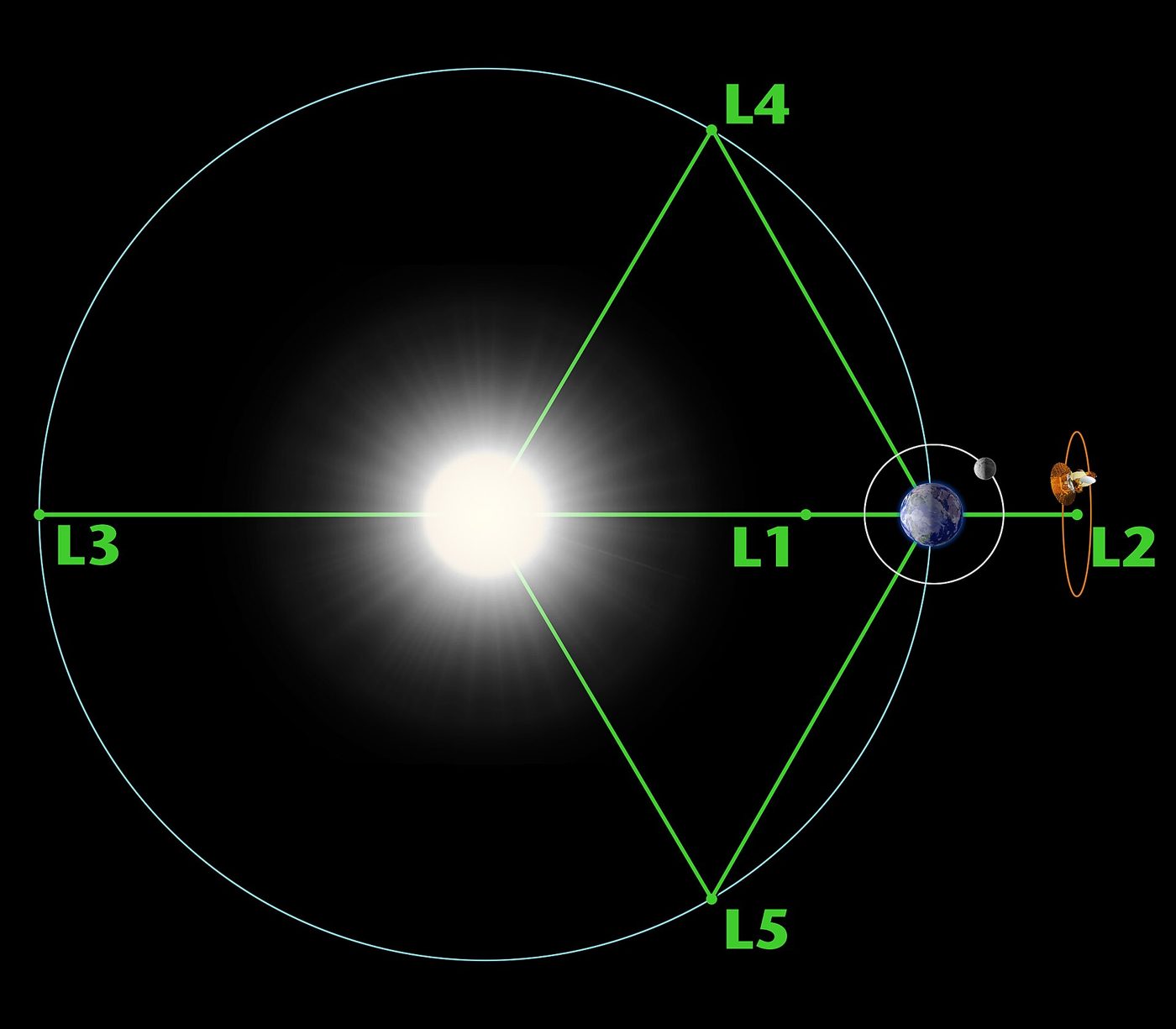
Discovered mathematically by 18th-century mathematicians Leonhard Euler and Joseph-Louis Lagrange, Lagrange points are five positions in space where the combined gravitational forces of two large bodies (such as the Sun and Earth) precisely equal the centrifugal force required for a small object to orbit in lockstep with them.
L1 (Between the Sun and Earth). Located 1.5 million kilometres toward the Sun, L1 offers an uninterrupted view of our star, making it ideal for solar observatories like SOHO and DSCOVR that monitor incoming space weather.
L2 (Behind Earth). Positioned 1.5 million kilometres directly away from the Sun, L2 lets a spacecraft keep the Sun, Earth, and Moon all behind its sunshield at once. This ultra-cold, stable thermal environment makes L2 the premier home for infrared and deep-sky telescopes like the James Webb Space Telescope, ESA's Euclid, and the upcoming Comet Interceptor.
L3 (Opposite Side of the Sun). Located directly behind the Sun on the far side of Earth's orbit, L3 is permanently hidden from Earth's direct line of sight, making it popular in science fiction but impractical for real missions due to communication blockages.
L4 and L5 (Trojan Points). Forming equilateral triangles with the Sun and Earth (60 degrees ahead and behind Earth in its orbit), L4 and L5 are the only naturally stable Lagrange points. Because gravity pulls drifting objects back toward their centres, space dust and asteroids (known as "Trojans") naturally accumulate there—and engineers often propose L4 and L5 as ideal locations for future large-scale rotating space habitats.
The Oberth effect leverages the squared relationship between speed and kinetic energy to make rocket burns far more efficient when a spacecraft is already moving fast, while Trojan asteroids are primordial time capsules trapped in gravitational balance at L4 and L5 points—with NASA's Lucy spacecraft entering Jupiter's Trojan region to inspect them up close.
1. The Physics of the Oberth Effect
Named after Austro-Hungarian rocketry pioneer Hermann Oberth in 1927, the Oberth effect demonstrates that firing a rocket engine at high speed produces a much larger gain in mechanical energy than burning the exact same fuel at low speed.
Kinetic Energy Scales with Speed Squared. Kinetic energy follows the formula E_k = ½mv². Because velocity (v) is squared, adding a fixed 1 km/s of speed when a rocket is already moving at 10 km/s adds far more kinetic energy than adding 1 km/s when the rocket is moving at 1 km/s.
Where the "Extra" Energy Comes From. Physics still strictly obeys the conservation of energy. When a spacecraft dives deep into a planet's or star's gravity well, both the ship and its unburned fuel convert gravitational potential energy into high speed. When the engine fires at the fastest point of the orbit (periapsis), the exhaust gas is left behind moving slowly deep inside the gravity well, transferring its leftover gravitational potential energy directly to the accelerating rocket.
Force Over Distance. Another way to picture it is mechanical work (Work=Force×Distance). Because a rocket engine pushes with constant thrust for a set number of seconds, a spacecraft travelling at peak speed covers a much greater distance during that burn—allowing the engine to perform far more mechanical work on the vehicle.
2. Trojan Asteroids and NASA's Lucy Mission
Trojan asteroids are ancient planetary building blocks trapped in stable gravitational pockets 60 degrees ahead (L4) and 60 degrees behind (L5) a planet along its orbital path.
Earth's Trojan Companions. Astronomers have confirmed two Earth Trojans—2010 TK7 and 2020 XL5—both orbiting near Earth's L4 point. Because they sit nearly in line with the Sun from Earth's perspective, they are difficult to spot with ground telescopes and require high fuel costs to reach.
Jupiter's Massive Trojan Swarms. Jupiter's immense gravity has corralled over 10,000 known Trojan asteroids into two sprawling clouds leading and trailing the gas giant. Scientists consider them "fossils of planet formation" because they have remained largely undisturbed since the outer planets formed 4.5 billion years ago.
NASA's Lucy Mission Status. Launched in October 2021, NASA's Lucy spacecraft completed main-belt flybys of the contact-binary moonlet system Dinkinesh and Selam in 2023 and the peanut-shaped asteroid Donaldjohanson in April 2025. In late October 2026, Lucy officially entered Jupiter's leading Trojan swarm for the first time in history.
Upcoming Trojan Encounters. Lucy is scheduled to make its first close Trojan flyby of Eurybates and its moon Queta on August 11, 2027, followed by Polymele (September 2027), Leucus (April 2028), and Orus (November 2028). It will then loop back past Earth in 2030 for a final gravity assist to visit the trailing L5 binary pair Patroclus and Menoetius in March 2033.