Artificial gravity, the Fermi Paradox, Dyson swarms and the search for alien technology
Artificial gravity engineering uses continuous rotation to simulate Earth-like gravity via centrifugal force in massive orbital habitats, while the Fermi Paradox explores the puzzling contradiction between the high statistical probability of intelligent extraterrestrial life and our complete lack of evidence for it.
1. Artificial Gravity Engineering and O'Neill Cylinders
Long-term exposure to weightlessness weakens bones, shrinks muscles, and impairs vision. Because physicists cannot generate real gravity without planetary mass, engineers simulate it by spinning a spacecraft so inertia pushes everything inside against the outer walls.
How Centrifugal Force Works. Inside a spinning ring or cylinder, the rotating floor constantly pushes occupants inward toward the central axis. To anyone standing inside, this inward push feels identical to gravity pulling them "down" against the outer hull.
The Coriolis Effect Challenge. If a rotating habitat is too small, it must spin very rapidly to generate 1g of gravity. Fast rotation creates noticeable Coriolis forces, meaning fluids in your inner ear slosh strangely whenever you turn your head—causing severe dizziness and motion sickness. To keep rotation gentle (under 2 revolutions per minute), a habitat needs a radius of at least 225 metres.
O'Neill Cylinders. Proposed by physicist Gerard K. O'Neill in 1976, an O'Neill cylinder consists of two massive, counter-rotating cylinders—each roughly 8 kilometres wide and 32 kilometres long—connected by a bearing system. Spinning them in opposite directions cancels out gyroscopic forces so the habitat remains aimed toward the Sun.
Living Inside a Cylinder. The interior surface is divided into alternating strips of land (with soil, lakes, forests, and towns) and massive glass windows. Giant external mirrors reflect sunlight through the windows to create natural day-night cycles, while the central zero-gravity axis hosts docking ports and low-gravity recreation areas.
2. The Fermi Paradox: Where Is Everybody?
Named after physicist Enrico Fermi—who famously asked "Where is everybody?" during a 1950 lunch conversation—the Fermi Paradox highlights the gap between the sheer age of our galaxy and the silence of the cosmos.
The Statistical Expectation. The Milky Way contains hundreds of billions of stars, many billions of years older than our Sun, with tens of billions of Earth-sized planets in habitable zones. Even if intelligent life is rare and travels at a fraction of light speed, an advanced civilisation could theoretically send self-replicating probes across the entire galaxy in just a few million years—a blink of an eye in cosmic time.
The Great Filter. One prominent explanation suggests there is an evolutionary or technological bottleneck—a "Great Filter"—that almost no species gets past. Either the leap from simple chemistry to intelligent life is extraordinarily rare (meaning the filter is behind us), or advanced civilisations inevitably destroy themselves through nuclear war, climate collapse, or runaway AI before expanding into space (meaning the filter lies ahead of us).
The Zoo and Dark Forest Hypotheses. Some theorists propose that advanced alien civilisations intentionally avoid interfering with developing worlds, treating Earth like a protected wildlife reserve (the Zoo Hypothesis). Others suggest the universe is a dangerous place where broadcasting your location invites destruction from paranoid rivals, prompting smart civilisations to stay completely silent (the Dark Forest Hypothesis).
Detection Limits and Non-Expansion. Finally, we may simply be looking in the wrong way or at the wrong time. Alien civilisations might communicate using neutrinos, gravitational waves, or tightly focused laser beams rather than leaky radio waves—or mature societies may choose to build virtual worlds and Dyson swarms around their home stars rather than colonising distant planets.
Dyson swarms and the Kardashev scale classify civilisations by their total energy consumption—from harvesting a single planet to capturing the entire output of a galaxy—while SETI's modern search strategies have expanded far beyond listening for radio broadcasts to scanning exoplanet atmospheres for industrial pollution and hunting for waste heat from alien megastructures.
1. Dyson Swarms and the Kardashev Scale
Proposed by Soviet astrophysicist Nikolai Kardashev in 1964, the Kardashev scale measures a civilisation's technological advancement based on how much usable energy it can harness.
Type I (Planetary Civilisation). A Type I civilisation captures all the energy available on its home planet—roughly 10¹⁶ watts—controlling weather, earthquakes, and global solar and geothermal resources. Humanity currently sits at roughly Type 0.73, still relying heavily on fossil fuels and early renewables.
Type II (Stellar Civilisation). A Type II civilisation harnesses the entire energy output of its host star (around 10²⁶ watts) by building a Dyson swarm. Contrary to popular sci-fi depictions of a rigid, solid shell—which would tear apart under gravitational stress—a real Dyson swarm is a dense, orbiting cloud of millions of independent solar-collecting satellites and habitats surrounding a star.
Type III (Galactic Civilisation). A Type III civilisation commands energy on the scale of an entire galaxy (roughly 10³⁶ watts), harvesting power from billions of stars, black hole accretion discs, and quasars across tens of thousands of light-years.
Building a Dyson Swarm. Constructing a swarm around our Sun would require dismantling a rocky planet like Mercury using self-replicating autonomous robots, converting its metals and silicates into ultra-thin solar mirrors that beam power via lasers or microwaves to habitats across the solar system.
2. SETI's Modern Search Strategies
While early Search for Extraterrestrial Intelligence (SETI) efforts focused almost exclusively on tuning radio telescopes to listen for deliberate alien beacons, modern astronomers look for technosignatures—unintended physical byproducts of advanced technology.
Waste Heat from Megastructures. By the laws of thermodynamics, even a hyper-efficient Dyson swarm cannot use 100% of a star's energy; it must radiate leftover heat away into space as infrared light. Astronomers scan sky surveys from infrared telescopes like WISE and James Webb to hunt for stars that appear unusually dim in visible light while glowing brightly in mid-infrared wavelengths.
Atmospheric Technosignatures. Using next-generation space telescopes to analyse starlight passing through an exoplanet's atmosphere, scientists can detect artificial chemicals that nature does not produce—such as chlorofluorocarbons (CFCs), nitrogen dioxide from industrial combustion, or greenhouse gases engineered to warm a cold planet.
Optical and Laser SETI. Rather than scattering wide radio waves into space, advanced civilisations might communicate between worlds using tightly focused, high-powered laser pulses. Optical SETI observatories use high-speed photon detectors to watch for brief, nanosecond flashes of laser light outshining a distant star.
Alien Artefacts in Our Solar System. Some researchers search closer to home, scanning Lunar Reconnaissance Orbiter imagery and tracking unusual interstellar objects—like 'Oumuamua—for signs of artificial probes, solar sails, or discarded hardware left behind in our own cosmic backyard.
Project Hephaistos is a Swedish SETI initiative that sifted through five million stars to find seven potential Dyson sphere candidates—though recent James Webb Space Telescope observations have already ruled out two of them—while interstellar visitors like 'Oumuamua, Comet Borisov, and 3I/ATLAS are rogue objects ejected from other star systems that have raced through our solar system.
1. Project Hephaistos and Dyson Sphere Candidates
Led by astronomers at Uppsala University in Sweden, Project Hephaistos searches massive astronomical catalogues—combining data from ESA's Gaia satellite, 2MASS, and NASA's WISE infrared telescope—for stars emitting unexplained excess mid-infrared heat, the telltale signature of a partial Dyson swarm.
Narrowing Five Million Stars to Seven. Using an automated filtering pipeline to eliminate nebulae, binary star blends, and known dusty young stars, the team identified seven M-dwarf (red dwarf) stars within 1,000 light-years that showed puzzling mid-infrared brightness matching Dyson swarm models.
The Background Galaxy Debate. Shortly after the candidates were announced, independent astronomers cross-checked radio surveys and suggested the extra infrared glow might actually come from distant, dust-obscured galaxies (known as "Hot DOGs") sitting directly behind those stars from Earth's line of sight.
James Webb Space Telescope Follow-Ups. In July 2026, Project Hephaistos researchers published follow-up observations using NASA's James Webb Space Telescope (JWST) on two of their top candidates (Candidates D and E). JWST's sharp infrared vision confirmed that both signals were indeed cosmic photobombs—distant background galaxies aligned within a single arcsecond of the foreground stars—leaving the remaining candidates awaiting future high-resolution checks.
2. Interstellar Visitors Passing Through Our Solar System
Unlike planets, asteroids, and comets that orbit the Sun in closed loops, interstellar objects travel on open, hyperbolic paths at extreme speeds, proving they formed around other stars before being flung into deep space.
1I/'Oumuamua (Discovered October 2017). The first confirmed interstellar visitor was a small, dry, cigar- or pancake-shaped object roughly 100 to 400 metres long. It baffled astronomers because it showed no visible comet tail or dust coma, yet accelerated slightly as it left the Sun—likely due to unseen outgassing of trapped hydrogen or nitrogen ice, though its unusual behaviour sparked public debate over whether it could be an alien light sail.
2I/Borisov (Discovered August 2019). Spotted by amateur astronomer Gennady Borisov, this second visitor looked and behaved much like a classic comet, sporting a bright icy nucleus and a long tail of gas and dust. Spectral analysis by Hubble and ground telescopes revealed it was unusually rich in carbon monoxide, suggesting it formed in the freezing outer reaches of a distant red dwarf star system.
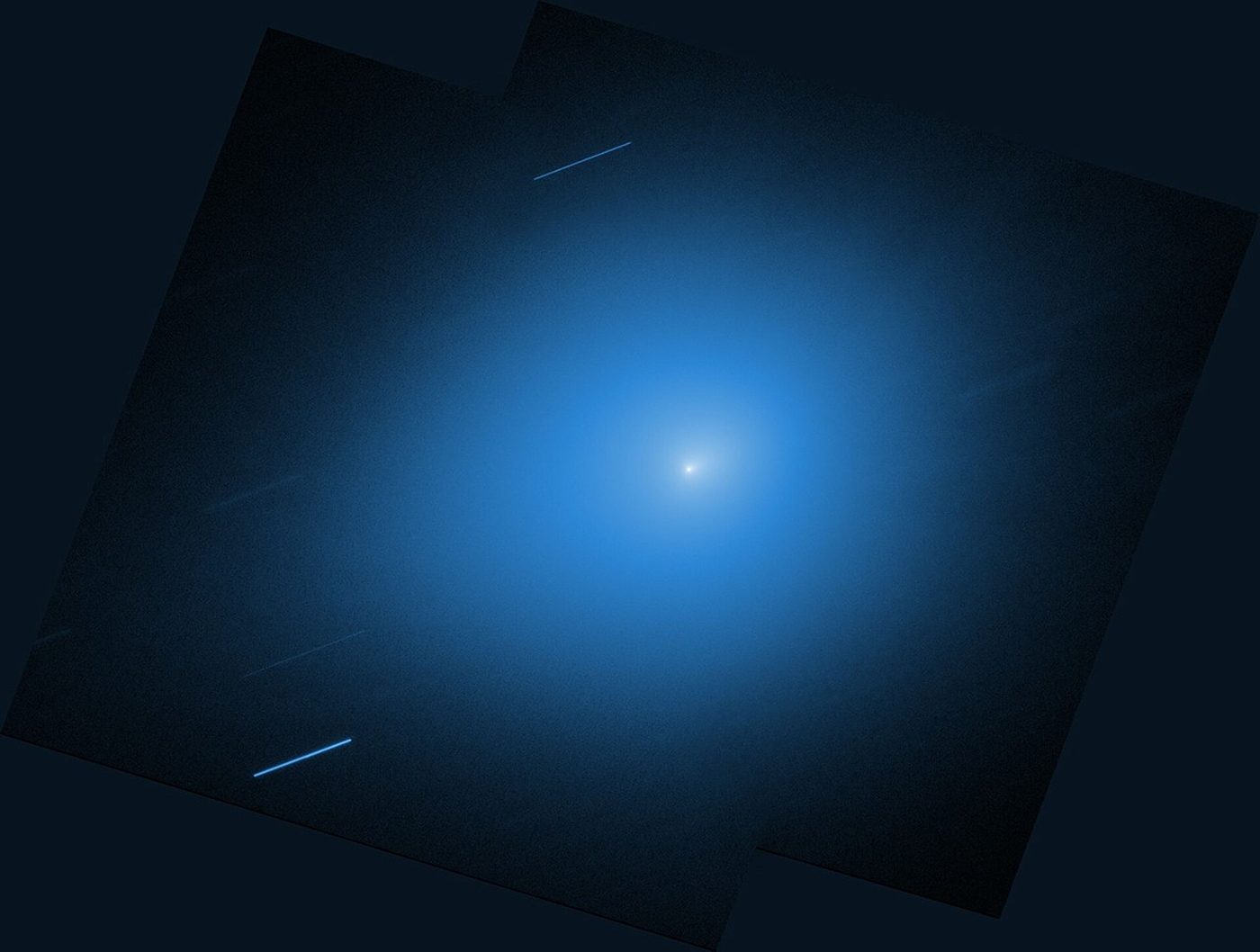
3I/ATLAS (Discovered July 2025). Detected by the ATLAS survey telescope in Chile, 3I/ATLAS became the third—and by far the largest and brightest—confirmed interstellar visitor. Measuring roughly 1 kilometre or more across and travelling at over 220,000 km/h (137,000 mph), this active icy comet was rapidly observed by JWST and Hubble as it swept past the Sun in late 2025, revealing a chemical fingerprint markedly different from native solar system comets.